







Cleanroom Equipment
Cleanroom weighing cover
The weighing cover is a kind of local purification equipment specially used in pharmaceutical, microbial research and scientific experiments place special local purification equipment...
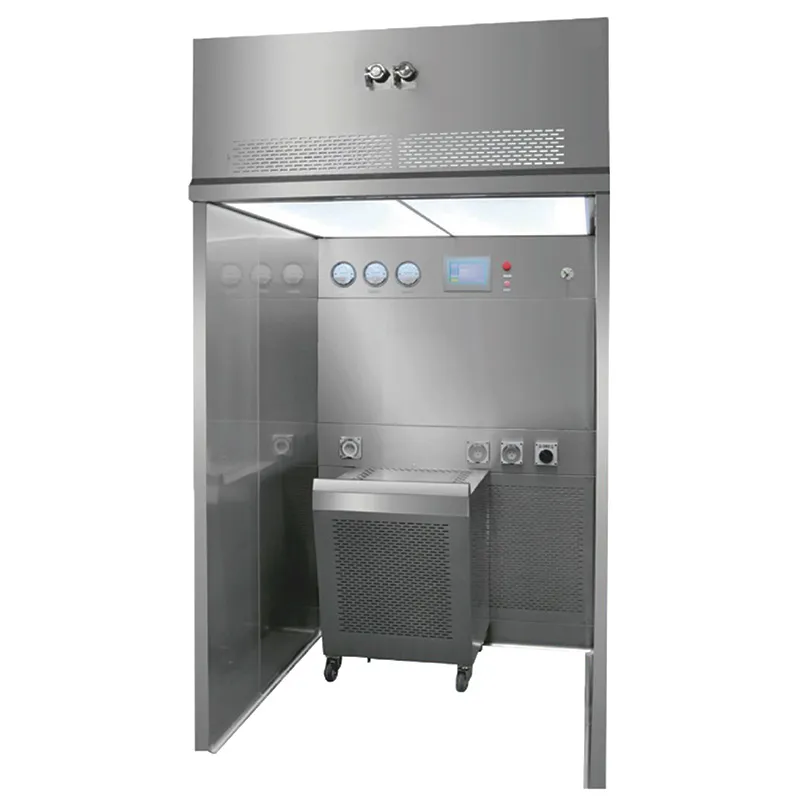
A clean room weighing cover is a precision-engineered enclosure designed to isolate analytical and micro-weighing operations from ambient particulate, airflow turbulence, and electrostatic interference. It integrates seamlessly into ISO Class 5–8 (Class 100–100,000) environments across high-regulation industries. Unlike generic laminar flow hoods or benchtop shields, this solution meets strict dimensional stability, material compatibility, and static-dissipative performance criteria required for repeatable mass measurement under controlled conditions. Its modular design supports rapid integration with existing Malaysia prefabricated cleanrooms and interfaces directly with structural clean room partition panels, ensuring continuity of containment integrity without compromising workflow ergonomics.
Technical Specifications
The following table outlines key physical, material, and operational parameters aligned with ISO 14644-1, USP <797>, and SEMI F21 standards. All units are factory-calibrated and verified per EN 13182:2021 for airborne particle control in weighing zones.
| Parameter | Specification |
|---|---|
| Internal Dimensions (W × D × H) | 600 × 450 × 500 mm (standard); custom sizes available up to 1200 × 800 × 700 mm |
| Material Construction | 316L stainless steel frame; 10 mm anti-static polycarbonate side panels (surface resistivity: 10⁶–10⁹ Ω/sq); anodized aluminum top plenum |
| HEPA Filtration | H14 grade (99.995% @ 0.1 µm), integrated vertical downflow at 0.45 m/s ±10% |
| Static Control | Grounded conductive base plate; optional ionizer module (±50 V offset, <±2 V drift) |
| Weight Capacity | Up to 30 kg on internal platform; vibration isolation compliant with ISO 20483 Class B |
| Certifications | CE marked; compliant with IEC 61000-6-3 (EMC), IEC 61000-6-2 (immunity), and UL 61010-1 |
Application Context Across Critical Sectors
In semiconductor and electronics manufacturing, the clean room weighing cover safeguards wafer-level chemical dosing, photoresist blending, and dopant powder handling—where sub-microgram deviations affect layer uniformity and yield. For biomedical and life science labs, it enables precise formulation of sterile injectables, cell therapy reagents, and reference standards under USP <797> and <800> compliance. In aerospace and precision optics, it supports calibration-grade mass verification of optical coatings, sensor substrates, and MEMS components sensitive to nanogram-level contamination. Food & beverage QA labs use it for allergen standard preparation and nutritional assay reference weighing, while automotive battery R&D relies on it for cathode/anode active material ratio validation. Data center infrastructure teams deploy it during ultra-low-particulate thermal interface material dispensing, and新能源 (new energy) facilities apply it in electrolyte additive synthesis and solid-state battery slurry batching—ensuring reproducibility where trace moisture or airborne organics compromise electrochemical stability. The unit functions as both a Weighing Protection Hood and a Cleanroom weighing cover, supporting dual-role deployment without structural modification.
Integration with Modular Cleanroom Infrastructure
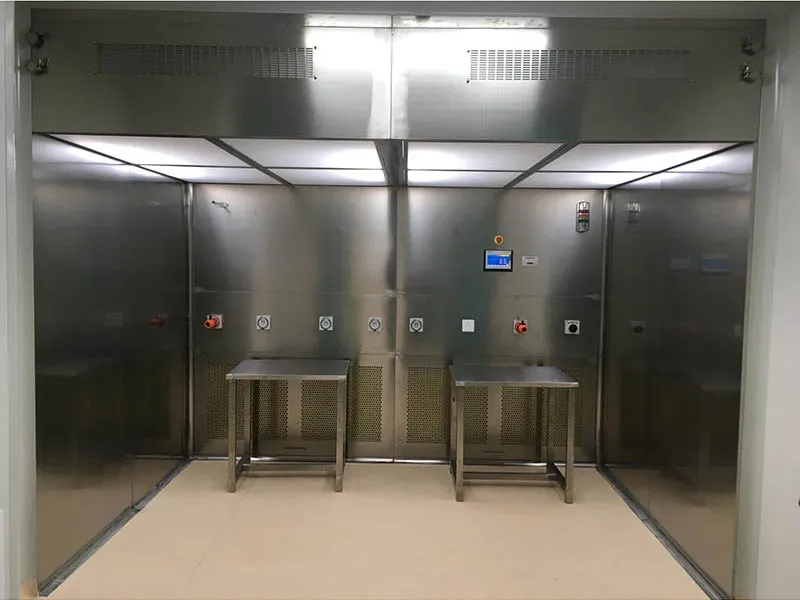
Compatibility with standardized cleanroom architecture ensures minimal retrofit effort. The unit mounts directly to floor-standing or wall-supported Malaysia prefabricated cleanrooms via adjustable anchor brackets that accommodate ±3 mm leveling tolerance. Side access ports align precisely with standard 600 mm module widths used in clean room partition panels, enabling flush integration with pass-through windows, utility sleeves, and interlock doors. Structural load transfer is distributed through reinforced base rails rated for 2.5 kN/m² static loading—compatible with raised-floor and epoxy-coated concrete substrates. No field welding or secondary framing is required. This modularity supports scalability: multiple units can be grouped into dedicated weighing suites while maintaining independent airflow zoning. Profile manufacturers and cleanroom manufacturer partners routinely specify this unit as part of turnkey cleanroom supplier packages—particularly where GMP, ISO 13485, or AS9100 workflows demand documented traceability from weighing event to environmental log.
Operational Longevity and Maintenance Protocol
Designed for >15 years of continuous operation in 24/7 production environments, the clean room weighing cover minimizes downtime through service-oriented engineering. HEPA filters feature quick-release cam-lock frames—replacements completed in under 8 minutes without tools. Polycarbonate panels are UV-stabilized and abrasion-resistant (tested to ASTM D1044 ≥150 cycles), resisting clouding from routine IPA wiping. Stainless steel surfaces accept passivation per ASTM A967 and tolerate repeated exposure to hydrogen peroxide vapor (HPV) decontamination cycles. All electrical interfaces meet IP54 ingress protection, and fan modules include predictive thermal monitoring with audible/visual alert thresholds. Maintenance intervals follow ISO 14644-3 Annex C guidelines: filter integrity testing every 6 months, airflow velocity verification quarterly, and full static calibration annually—documentation templates provided for audit readiness. As a critical component in regulated weighing workflows, it delivers consistent performance whether deployed by a cleanroom supplier serving Tier-1 automotive OEMs or a profile manufacturers supporting ASEAN-based biologics fill-finish lines.
Get a project-specific quote in 24 hours
Send your cleanroom classification, floor area and finish requirements. Our Malaysia-based engineering team replies with a stamped datasheet, fire certificate and pricing — 7×24 technical support by email, phone or WhatsApp.
Chat on WhatsApp